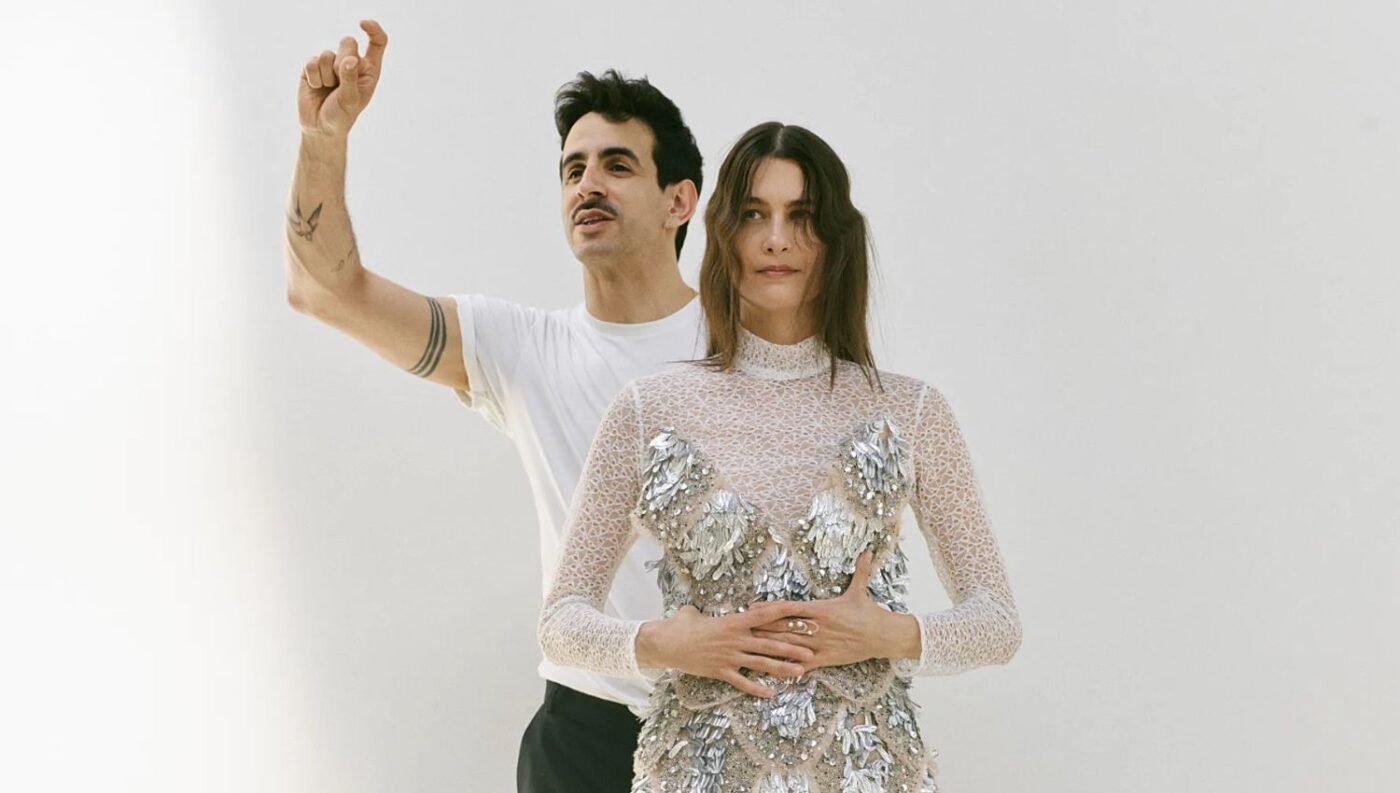
The French-Portuguese designer trained as an architect, cuts his patterns in 3D and thinks the industry’s rush to replace models with AI will cost smaller labels most.
One of the more closely watched names at this year’s Paris Fashion Week is one many people outside the industry won’t recognise yet.
Steven Passaro has collected endorsements from LVMH, the Fédération de la Haute Couture et de la Mode and the French Ministry of Culture. The French-Portuguese designer studied at the Duperré School of Applied Arts in Paris and at the University of the Arts London, then worked at Hermès, Loewe and Christian Dior before starting his own label.
Speaking to Euronews Culture, he talked through where his silhouettes come from, why his patterns are made on a screen, and what he makes of luxury houses swapping models for generated imagery.
Architecture came first
Passaro calls architecture his first love, and credits it with training him to think in three dimensions. Carrying those skills into clothing felt like a continuation rather than a change of direction.
You can see it in the work. He describes two fundamentally different approaches to dressing a body: the Western habit of cutting fabric to a body’s shape, and the Eastern tradition of wrapping fabric around it. He wanted both in conversation inside the same silhouette.
Architecture, he says, gave him the tension to hold that duality — sculptural, almost structural forms in one place, fluidity in another. The aim is a design language he can keep evolving rather than a look he has to reinvent every six months.
One story, told from different angles
His Spring-Summer 2026 collection, Moonlit Lover, dealt with toxic love: secret affairs, late-night obsession, illusions that damage more than they mend. Fall-Winter 2026, Ethereal Shift, turned to personal transformation and finding meaning in a chaotic world.
Passaro doesn’t treat these as separate projects. He reaches for the French phrase le fil rouge, the guiding thread, and insists there’s no break between seasons. One central theme, approached from a new angle each time, with a movement from point A to point B built into it. However structured that sounds, he describes the actual work as intuitive.
His references come from psychology, from spirituality, and from whatever the world is currently doing.
The most recent collection he calls the glimpse. It’s the sensation of standing at the threshold of something you want and are frightened of at the same time. He’s explicit that this is how the political moment feels to him: good things and bad things happening simultaneously, and that pull between wanting to step forward and not daring to. He’d like the next season to come out lighter.
Patterns in two hours, not three days
Passaro builds his garments digitally before anything is cut, which still sets him apart from most of his peers.
He found the software at the London College of Fashion, in a department dedicated to fashion technology and where the industry might be heading. It struck him immediately as the thing he’d been doing in architecture, translated. He describes himself as a nerd, so experimenting with it was never going to be a hard sell.
The maths settled the argument. A pattern that takes him two or three days by hand, sometimes longer, takes two hours digitally.
That’s the point, and it isn’t a rejection of craft. Passaro’s reasoning is that time saved on pattern-cutting is time and money returned to the making. Couture and bespoke tailoring demand hours at the machine with your hands on the fabric, and going digital upstream is what protects those hours.
Virtual sampling, European fabric
Sustainability runs through the same decision. Passaro says the whole product development phase is planned around doing less environmental harm.
Using Style3D software, his studio does virtual sampling and virtual pattern cutting on a digital avatar, which cuts waste before any fabric is touched. The fabrics themselves are sourced in Europe, from LVMH. He’s careful not to present this as solved: there’s plenty still to learn, and the process gets refined as they go.
On Shein, and the €3 t-shirt
In 2025 Shein opened a retail space inside BHV in Paris. The backlash was substantial, and BHV eventually called the partnership a strategic mistake and pulled out.
Passaro’s response is that the gap is one of consumer education. He does the arithmetic out loud: a €3 t-shirt shouldn’t be physically possible, because the fabric alone costs more than that per metre, and it will be finished after three washes. Spend €15 to €20 and you might get 10 to 20 washes out of it, which works out cheaper.
He supports the new European and French rules on ultra-fast fashion, arguing that regulation is needed to protect both people and the environment. He also acknowledges the awkwardness of the conversation, because people are working with very different budgets for clothes.
Where AI actually hurts
On the growing use of AI for campaign imagery, Passaro’s objection is aimed squarely at the top of the market. When big corporations do it, he finds it questionable, because those are precisely the companies that can afford models, photographers and stylists.
Strip the humans out of the images and jobs disappear. He says plainly that he doesn’t want to replace models with AI, and that gathering people in a room and trading ideas makes the work more creative, not less.
He also traces a knock-on effect that smaller labels feel directly. If the major houses stop paying models, the burden of sustaining that ecosystem falls on brands like his, at a time when he says agency fees have doubled or tripled compared with a year earlier. Independent designers can’t absorb that. For Passaro, the responsibility sits at several points in the chain at once: reputation, industry health, and the people whose livelihoods depend on it.
Advice for anyone starting a label
Passaro used to lecture at the French Institute of Fashion, and his advice to young designers is blunt: don’t run. Chasing a checklist of magazine features, press coverage and a fashion week slot is punishing and largely pointless.
What matters instead is being smart about product design, finding your actual audience, and assembling the right people around you — friends, contacts picked up along the way, business partners.
He adds one caveat about criticism. Listen to feedback, but not too much of it, and keep a filter running.
Take your time, he says. It’s a marathon, not a sprint.