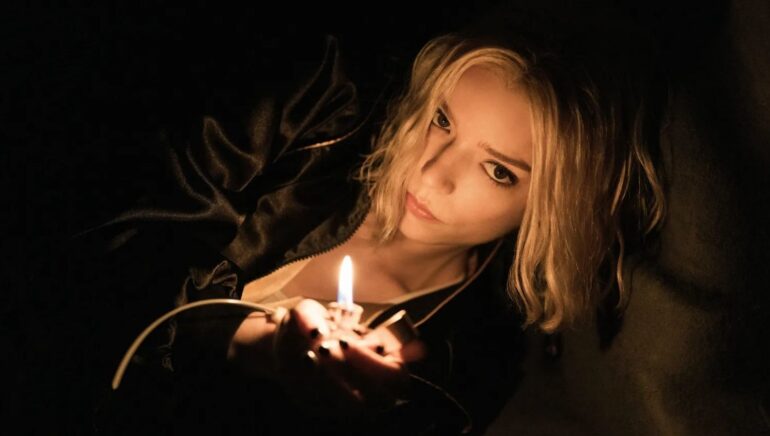
In the writers’ room for Lucky, showrunner Cassie Pappas kept coming back to Heat. The Apple TV miniseries bears little resemblance to Michael Mann’s 1995 crime drama, but its writers were gripped by the age-old game of cat-and-mouse, two people locked in a chase because they know nothing else.
“We’ve seen this idea of a person on the run and a dogged law enforcement chasing him,” Pappas tells Marie Claire over Zoom ahead of Lucky’s two-episode premiere. “Our show now has three women doing that. We have a female criminal (Anya Taylor-Joy), a female mob boss (Annette Bening), and a female FBI agent (Aunjanue Ellis-Taylor). How does that genre change when women are at the helm?”
Based on Marissa Stapley’s novel, the series was first popularized as a Reese Witherspoon’s Book Club selection before landing with Pappas, whose credits include Silo and Griselda, and co-showrunner Jonathan Tropper of Warrior and See. Taylor-Joy, attached to the project from the start, plays a grifter often underestimated for her size, age and gender. “Nobody thinks that she’s the smartest person in the room, when actually, every single time, she is,” Pappas says.
While Tropper was in New York filming another Apple TV title, Your Friends and Neighbors, Pappas ran the set for Lucky, which unfolds as an electrifying desert chase across seven episodes. As action-packed as the series is, it never strays from its emotional core, the relationship between Taylor-Joy’s character and her con-artist father, played by Timothy Olyphant. With Olyphant’s John in federal prison and Lucky unsure whom she can trust, she grapples with an identity crisis while on the run.
“I won’t give anything away, but a big action sequence ends in her realizing, ‘My cons have real consequences,'” Pappas says. “We were always trying to have an emotional depth piece connected. If we’re going to crash a car, we want it to also make you feel something deep about the character.”
Adapting the novel with Hello Sunshine
Reese Witherspoon and Lauren Neustadter of Hello Sunshine secured the rights to the book and stayed deeply involved at every stage, according to Pappas. They were always on set, gave detailed notes on scripts, and were the most hands-on producers she has ever worked with. The project was more muscular and action-packed than some of their past shows, and they were eager to lean into that, as well as being responsible for attaching Taylor-Joy. Every word, Pappas says, was written with the actress in mind.
What drew the team in most, though, was the dysfunctional father-daughter relationship at the story’s heart. Tropper handles dysfunctional families well, having written This Is Where I Leave You, and Pappas felt equally primed to explore the theme. The stakes came from questions about inheritance: how am I like my parents, what baggage have I inherited, what am I genetically predisposed to?
Lucky’s father is a con artist and a criminal who raised her to be an extension of himself. She was born into a life of crime she did not choose, but she is remarkably good at it because he shaped her in his likeness. As she tries to leave that world and come of age, a theme of self-awareness emerges. She is physically running from external forces, but internally the real conflict is whether the thing she is running from lives in her blood, and whether she can outrun it and become the author of her own life.
Casting Annette Bening and Timothy Olyphant
With Taylor-Joy in place, the next crucial role was Priscilla, the mob-boss adversary. Bening was always the top choice, though no one quite believed they would land her. When the script went out, she leaned in and wanted to hear more, and once it became real it felt as natural as any other casting. Olyphant came aboard through Tropper, who had worked with him before, and through a relationship Neustadter had with him, though Pappas understood he had also heard about the part and was very interested himself.
Building the action
Pappas believes Hello Sunshine went to Tropper first because of his action-heavy background. The word “muscular” came up constantly, alongside “bingeable” and “propulsive,” as the team aimed for something that would pull viewers through.
The pilot is a full sprint that ends with a huge action set piece, which allowed the second episode to slow down, letting Lucky hide, lick her wounds and plan her next move. That gave the show room for character work. The action was never meant to exist for its own sake, Pappas says, and always needed emotional depth or truth behind it.
Writing Lucky as a mystery
In the early episodes, Lucky is deliberately mysterious. One thing Pappas connected to was the idea that underneath all the masks, the character has no idea who she is, and that terrifies her. Lucky has spent her whole life reading the room, reflecting back to a mark whatever they want to hear before conning them, and it is only after she leaves that people realize they were taken. As long as she is wearing a mask, she feels confident.
As she comes of age and physically runs, the distance gives her space to ask who she really is. If she is not conning people, she does not know who she is.
The art of the con
The show is full of betrayal, something Pappas leaned into through research in the early days of the writers’ room. Having never written a con artist before, it was the element she felt most insecure about. The team read The Confidence Game, which proved especially insightful. Con artists, it suggests, live in a constant cycle of trust and betrayal, gaining trust, getting what they want, then betraying, and the book raised the possibility that this pattern can be rooted in childhood experiences of trust and betrayal that a person may be unknowingly working through.
Lucky’s moral compass
Asked how Lucky fits into a world she does not want to belong to, Pappas frames it as nature versus nurture. Lucky is her father’s daughter and inherently good at the work, but she may not want to use those skills. The choices she makes across the seven-episode arc reveal her moral compass, her desire for freedom and her wish to stop running. There is something beautiful, Pappas says, in admitting you do not know who you are while being excited to find out.
Women take on many labels that define who they are, she adds, mother, daughter, wife, sister, and if you untether yourself from each one, the question of who you really are becomes harder to answer. Lucky does not know the answer, which pushes her toward wondering whether she simply wants to be free of all the masks and labels, and what that kind of life might look like.
A favorite scene
Among Pappas’s favorite sequences is one in episode 2, when Lucky hides out in a desert ranch house while the FBI agent searches inside. Its simplicity is the opposite of an action set piece, yet it is tense and edge-of-your-seat, carried by exquisite performances from Aunjanue Ellis-Taylor and Taylor-Joy. Once the agent is inside, there is little dialogue, just her crawling from one room to the next. It read well on the page, Pappas says, but became far better once they shot it.
Lucky airs on Wednesdays on Apple TV, with new episodes through August 19.