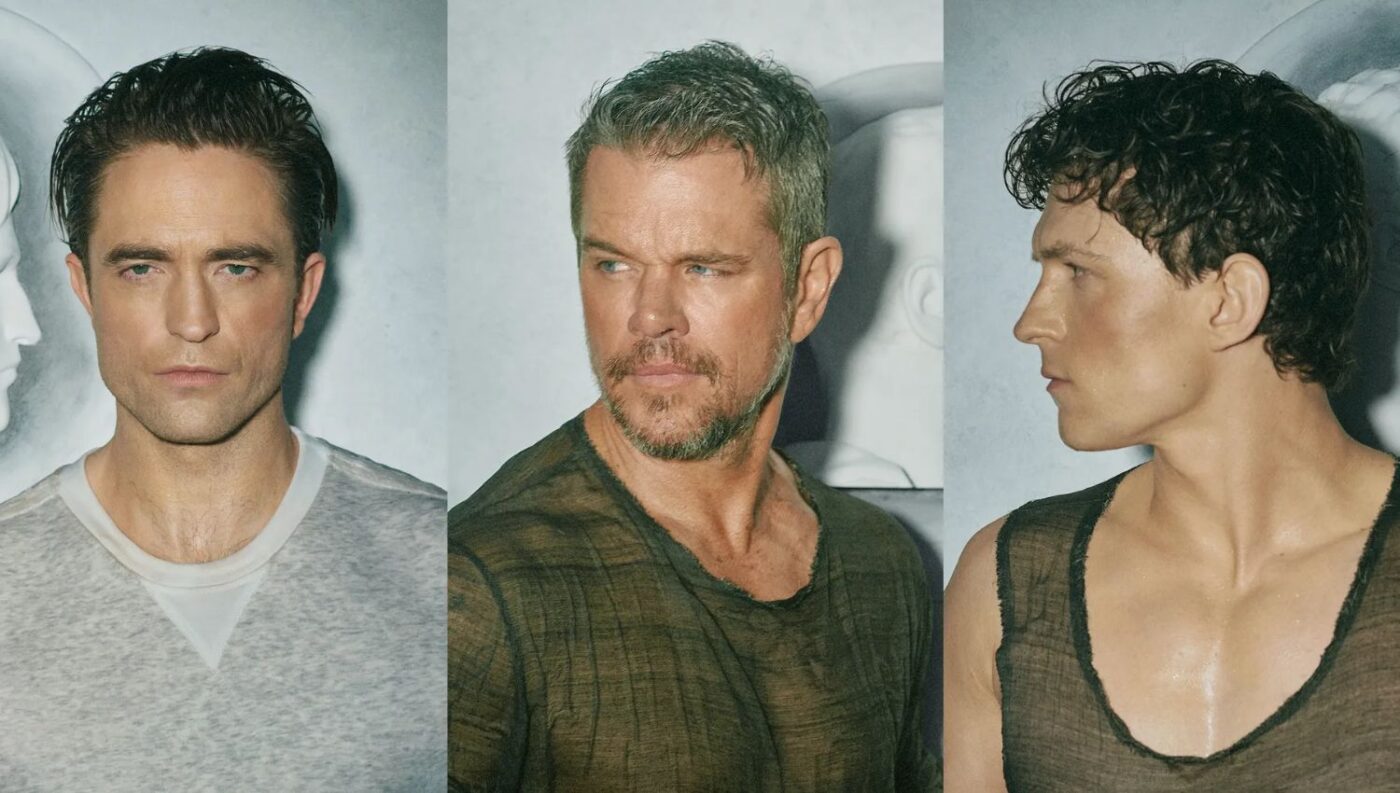
Matt Damon believes it is the last film of its kind he will ever get to make. Tom Holland credits it with rescuing his Spider-Man. Robert Pattinson mostly wanted leopard-print underwear under his skirt.
Directors solve problems for a living. Christopher Nolan solves them at a scale that occasionally involves purchasing vehicles.
On “Tenet,” Robert Pattinson turned up on set in Estonia to shoot a scene that required him to drive in reverse. The crew had a rig for it, a device Pattinson calls a pod, bolted to the car so a concealed stunt driver could steer it backwards. One problem: the pod didn’t fit any of the cars they had. Nolan’s stunt coordinator had used the same pods on BMWs before, so the suggestion was simply to visit the nearest BMW dealership and buy two. They lost roughly 45 minutes. After all the planning, Pattinson says, they just bought the cars and shot the scene.
Some problems don’t have a dealership solution. On “The Odyssey,” one location sat 270 metres up a mountainside, and there was no clever fix available, so Nolan carried on regardless. Anyone who could climb, climbed. Everyone else went up by helicopter, which also ferried equipment in both directions. His team assembled a scaffolding platform on the slope for lunch breaks, engineered to hold the combined weight of 200 crew. For two weeks in the middle of the shoot, the entire unit was on call at altitude, climbing at whatever pace their legs allowed.
Pattinson, who plays Antinous, one of the suitors circling Penelope, and Holland, who plays Odysseus’ son Telemachus, did the climb in costume and sandals. For Nolan it meant watching Holland, then 29 and in serious condition, sprint past him up the hill every morning.
Matt Damon plays Odysseus. He has worked on 80 film sets. On any other production, he says, every single location on this one would have been the hardest of his career. Here they simply arrived one after another.
Ninety-one days, six countries
“The Odyssey” was shot across 91 days in 2025 in Morocco, Greece, Italy, Iceland, Scotland and at the Falls Lake water tank on the Universal Studios lot in California. Nolan ran more than 600 kilometres of IMAX film through the cameras.
Pattinson landed in Favignana in early April 2025 and found the resort he was staying in completely empty, out of season. Filming had already been running for over a month. He sat alone in the hotel bar until people started filtering in, and he says he has never seen a group of people look so wrecked. They were a third of the way through and had already worked in two countries. By the end of each day, everyone was finished.
Holland arrived in Morocco first and couldn’t locate the film. He walked along the beach for half an hour past Greek soldiers, Greek boats, more soldiers, the Trojan War, more boats. He isn’t sure whether he’s exaggerating, but it felt like kilometres. He eventually asked a production assistant where the crew was, because what he was looking at read less like a set and more like a historical reenactment.
Damon’s reaction on arrival was blunter. Who, he wondered aloud, thought you could shoot a film here.
The budget came in around $250 million, and the studios have long since stopped arguing with Nolan about scope, largely because the scope shows up on screen. Damon watched the crew build a mountainside platform in record time so a telescopic camera crane could sit on it. Assistant director Nilo Otero clocked his amazement and pointed out that every person on that mountain could be working on an easier film for more money. Damon concedes the point.
Nolan himself has grown fairly relaxed about all of it. “Inception” was the first time he announced a seven-country shoot, back in 2010, on the assumption that it should have been impossible and that they would work it out anyway. He discovered he runs on that kind of difficulty. Moving from Iceland to Scotland to Morocco energises a crew in a way that months in one place never does.
Damon puts the scale in surfing terms. It’s like riding a bigger wave, he says, and a wave twice the size isn’t twice as powerful. It’s exponentially stronger.
The blockbuster rules he keeps ignoring
Nolan is a strange kind of commercial filmmaker. His films cost a fortune and wrestle with time and space in ways that don’t always land cleanly, including with the people in them. Pattinson, who starred in “Tenet” opposite John David Washington in 2020, has admitted he didn’t fully grasp what the film was about. In the last week of shooting he turned to Washington and said he thought he was dead, that he had always been dead. Washington told him he wasn’t dead and asked what he was talking about.
The commercial logic holds anyway. “Dunkirk” in 2017 was built from a 76-page script with almost no dialogue. “Oppenheimer” in 2023 was largely black and white and a biopic of a theoretical physicist, and it took nearly a billion dollars, 13 Oscar nominations and seven wins, including Best Picture and Best Director.
Most directors at his level have at least one real failure behind them. The variables are too many and audiences too unpredictable for anything else. Nolan’s record has no such entry. He has never made a genuinely bad film, and not one of them has grossed less than it cost.
He is reluctant to explain why, then offers a theory anyway. If you love films and the history of them, he says, you understand that audiences want something new, something they don’t yet know they want. The only certainty available is uncertainty. He calls it a paradox, admits it frightens the people financing him, and says there’s no alternative: you risk everything on every project.
Inside the mixing room
In February he is at Warner Bros. Studios, in the first week of the final sound mix. The choice of building says something. Nolan publicly moved from Warner to Universal a few years ago, yet the mix happens here, in a two-storey building whose foyer carries a poster for Clint Eastwood’s “Unforgiven.” His wife and producer Emma Thomas answers the door and waits until word comes back that he’s ready.
The mixing room is large, panelled for acoustics, and littered with the usual post-production debris of old newspapers and cold coffee. Nolan sits in an armchair in a blazer, open-collared shirt and dark trousers, beside Jennifer Lame, who has cut his last three films. His sound team flanks them, split across dialogue, music and effects.
On screen, Telemachus arrives at a castle banquet and is confronted by Menelaus. Nolan is listening past the dialogue to the layers of background voices, and he isolates one laugh that sits too loud. He calls it risky. Nobody in the back row should wonder whether the crowd is laughing at the scene rather than in it. Faders move, levels change, the track comes back.
He thinks he liked it. One of his engineers asks whether it was a bit chaotic. Nolan says it was a good kind of chaos, and his face opens up.
He would rather you just said yes
Nolan is well liked and slightly feared, and he is unusually direct about who he wants. When he called Pattinson about “The Odyssey,” the actor said he looked forward to reading it. Nolan’s response, as Pattinson tells it, was to ask why he wanted to read it, since everyone else had simply said yes.
Holland had a harder answer to give. The schedule collided with “Spider-Man: Brand New Day,” and his obligations to that franchise are not negotiable. He told Nolan he wanted the part but would have to make a very uncomfortable phone call first, then made it, to Sony Pictures chief Tom Rothman. Sony moved the dates.
Holland thinks that happened partly out of respect for him and largely because of Nolan’s reputation for not overrunning. The film wasn’t going to swallow five extra months or lose Sony their lead for two years. With almost any other director, he suspects, the conversation goes differently.
Shooting on “The Odyssey” started on the day Nolan said it would and finished nine days early.
Why it keeps coming back to time
Time has been his subject since “Memento,” his second feature, which runs forwards and backwards at once. “Inception” and “Interstellar” are about never having enough of it and being stranded outside your own life watching it go. In “Tenet,” characters travel in both directions and tangle themselves into knots. “Dunkirk” runs three timelines at three speeds, on the logic that an hour can feel like a week and the reverse is equally true.
He gets asked about it constantly. His casual answer, which he thinks is also the right one, is that he has always lived inside time. It drives everything, it is what we push against, and it torments all of us continuously.
Pattinson says there is something close to mystical about him, a mystery he would deny having. What isn’t mysterious is how visibly the films track his life. When he married, Nolan says, he made films powered by a man’s dead wife. Then he had children and started making films about that instead.
Damon, a father of four, read the “Interstellar” script on another set while working abroad, only two weeks away from his own young children and already not really present with them. The script is about missing a childhood entirely. He called Nolan afterwards to ask what exactly was wrong with him.
Nolan and Thomas have four children too. So many of his films, he says, sit on the tension between wanting to be with your family and the outside commitments that drag you away from them.
Homer’s structural problem
That tension has scaled up with the films. He and Thomas have always worked from the belief that a successful project creates an obligation to ask what you are now permitted to attempt that you weren’t before, because those windows don’t open often. “The Dark Knight” bought him “Inception.” “Oppenheimer” bought him the most ambitious idea he could find.
Rereading the poem, he identified the problem immediately. “The Odyssey” is all climaxes and contains no setup. Take Argos, the dog who recognises Odysseus when nobody else does, arriving with no preparation whatsoever. Everything cinema does by reflex, planting in the first act what pays off in the third, is missing, because Homer’s listeners already knew the story and needed no groundwork.
So the screenplay became an exercise in building that groundwork and then honouring it, setting things up inside the poem’s own shape so that a modern audience arrives ready for climaxes it hasn’t been briefed on. That, he says, was the breakthrough.
The camera that had to be invented
He also knew from early on how he wanted to shoot it, which created a technical problem. IMAX cameras deliver enormous, absurdly detailed images, and they are bulky and loud, which is why they have historically been pointed at landscapes and action rather than two people talking.
At Nolan’s request, IMAX developed a shell, something like an airship, to muffle the camera while still letting the actors hear each other. The shell then blocked their sightlines, so Nolan improvised a mirror system that threw each actor’s face up beside the lens, letting them look directly at one another around the hardware.
Holland’s summary of the working method is that Nolan fakes nothing. Everything is real, and whatever you react to is precisely the thing he wants your instinct to respond to.
Pattinson had a scene reacting to a distant sound, with nothing in his eyeline but the camera. He asked whether the sound would be cut in later and where he should be looking. Nolan told him Damon would handle it. Damon and Anne Hathaway then played the entire scene roughly 60 metres away, out of Pattinson’s sight, so that Damon could kick a bowl at the right moment and Pattinson could hear it. He describes this as completely insane.
Damon values the flip side of that literalism. Everything is on the page, he says, no secrets, so you know exactly what your day contains. Your character is going to be tied to a mast and have an existential crisis, and that means a real mast on a real boat on real open sea. As an actor he calls that a gift, because you can prepare for it rather than turning up at a studio and discovering you’re being tied to something.
Nolan first used IMAX on “The Prestige” and worked out what it could really do on “The Dark Knight.” He wants to hand audiences something they can believe in, even when that requires the open ocean and a camera roughly the size of a Beetle. When they premiered the “Dark Knight” prologue, nobody had used those cameras that way outside documentaries and museums. Every time the frame opened on the helicopter shot above the bank the Joker is about to rob, the audience gasped. He calls that the secret ingredient, the strange combination of intimacy, where you feel you know how everything smells and tastes, with something monumental happening at the same time. Talking about it is the happiest he looks all afternoon.
Tom Holland pressed reset
Holland is in Los Angeles this spring for no particular reason. He lives, he says, wherever the wind takes him. Yesterday Miami, soon London, where he owns a house, then hopefully Paris and Rome, then possibly back to LA to join his partner Zendaya on the tour for her film “The Drama.” Zendaya is also in “The Odyssey,” though they share no scenes. He turned up on her first day of shooting because he wanted to be there.
Ahead of him is the press tour for his first two major films since 2022, “The Odyssey” and “Spider-Man: Brand New Day,” and he says he’s leaving no stone unturned.
When we first spoke in 2019 he was 23, looked younger, and lived outside London with his brothers and friends among dartboards and Avengers posters. He was drinking then, having a great deal of fun, deep in the Spider-Man years he calls the best of his life, falling in love, proud of his work. Now, at 30 and no longer drinking, he describes reaching a point where he could hit reset and close the chapter on being a kid in Hollywood.
We meet at Soho House in West Hollywood. He still looks strikingly young, which is probably why he keeps getting cast as somebody’s son, and he still triggers a protective streak in his older colleagues. Damon says he admires him, and notes that Holland and Zendaya, separately and together, absorb far more attention than he ever had to, and handle it with grace.
The only visible change is a certain ease. He needed the break, he says. He had overworked himself and needed to grow up in his personal life, which meant time at home. He also wanted to check he was still fully committed, because the moment the work becomes an obligation something has gone wrong. He never quite doubted that he loved it, but he had started to feel he was just showing up. During the sabbatical he played a lot of golf, bought the London house and worked out who he was besides a very famous actor.
Pattinson, who has now made three films with him, thinks Holland lived his wild years on schedule, over about eight, whereas he stretched his own out indefinitely and intends to be 22 until he’s 39. He finds Holland’s generation notably sensible.
Holland pushes back gently on wild. Lonely, more often. He wasn’t a nightclub person. He was the type to sit in a hotel room, work through the minibar and go to work the next morning. Not very Hollywood. Sensible, in fact, with too much drinking attached.
What ended the break was the Spider-Man contract and Nolan’s phone call. Holland argues “The Odyssey” made the new Spider-Man film better, and possibly saved it. Sony’s postponement created the room to bring in Destin Daniel Cretton, director of “Short Term 12,” “Just Mercy” and “Shang-Chi and the Legend of the Ten Rings,” who wasn’t free when they originally wanted to shoot. Those extra six months went into the script. Holland believes the result is the best version of a Spider-Man film to date, and thinks Sony, having swallowed a bitter pill, are now grateful.
Nolan’s efficiency floored him. He came out of the Marvel system, and says, with an apology to Marvel, that the level of preparation was unlike anything he had experienced. There isn’t a question Nolan can’t answer on the spot, and his approach is direct: occasional camera trickery, but mostly turning up and finding the right angle. Holland’s first sequence was scheduled for two days. Over lunch Nolan announced they’d manage it in one. They were done by nightfall.
His Spider-Man colleagues got used to hearing Nolan’s name. Holland pushed the point that a crew shouldn’t arrive on set to work out what happens next, and that everyone needed a reason for making the film beyond it being the fourth one, a big summer and a lot of money. Cretton drove most of that, but Holland says it helped enormously to be able to call the studio and producers Amy Pascal and Rachel O’Connor and tell them how Chris does it.
Then there is the quote. In 2021 he told this magazine that if he was still playing Spider-Man past 30, he’d done something wrong. He turned 30 in June. Revisiting it, he thinks he meant he wanted to pass the torch eventually, which he hasn’t done yet, so perhaps the number should be adjusted to 37. He also wonders, with that familiar grin, whether he was trying to spook Sony during a contract negotiation. Either way, he sees it differently now. Playing Spider-Man, he says, has been the greatest joy of his life, and he’ll keep doing it as long as they want him.
This year he shoots a smaller film he can’t discuss, and next January he hopes to start the long-gestating Fred Astaire biopic. After that he intends to stop and breathe rather than repeat the mistakes of his twenties and the compulsion to keep working. Right projects, right people, one day at a time.
Robert Pattinson is bad at this part
Pattinson sits on the patio of the Polo Lounge at the Beverly Hills Hotel, hair everywhere. He has lived in and around this hotel on and off since “Twilight” made him famous. He once owned a large house in Los Feliz which he drifted through like a ghost before selling it. He now rents in Beverly Hills with his partner, the singer Suki Waterhouse, and their young daughter.
It’s his first time living here, and there’s a gym in the house. He always thought of himself as an East Side hipster, he says. He only came for the agency. Now he suspects everything here is quite nice and that he may have become a snob.
We last met in 2020, mid-pandemic, over a series of interrupted calls and blurry FaceTimes, which suited him. He arrives at the Polo Lounge already nervous. Is it Oscar weekend? It is, and he has no idea, though days later he will appear on television presenting Best Director to Paul Thomas Anderson alongside Zendaya. “The Drama” is also out soon. He confesses he has forgotten which film he is promoting, then adds that it hardly matters since he’s terrible at discussing his own work and has forgotten how interviews function.
The gym was for “The Batman: Part II,” about to start shooting. The stunt coordinator recently mentioned eleven weeks of night shoots, which was news to him, as no schedule has arrived. On the gym generally, he is still annoyed that after the first “Batman” everyone assumed he hadn’t trained. He trained every day, sometimes twice, occasionally at three in the morning, and still looks, by his own assessment, like a man who has never exercised. He blames an interview in which he claimed exercise was uncool, given because he wanted to sound cool.
His daughter turned two a few days before we met. She has come along for everything: Suki’s tours, every shoot, Mardi Gras in New Orleans, a long stretch in Boston. He thinks fatherhood has made him calmer and given him an enormous amount of energy. He did nothing at all for five months after she was born. He maintains he barely works anyway, filming a few months a year outside “Batman” and spending the rest of it locating the next party. That phase has ended in favour of going to bed absurdly early, which he finds ridiculous, and he cites a TikTok that framed early bedtimes as a kind of addiction: have you tried going to sleep at seven, it’s really fun.
“The Batman: Part II” shoots in London near Leavesden Studios, where Warner Bros. is also making the new “Harry Potter” series, which means an on-site school for the child actors. Pattinson, who played Cedric Diggory in the original films, knows exactly what such a place looks like, and has already had a look around and asked about enrolling his daughter. This, he decided, is where she’ll go to school. At Hogwarts. It may genuinely be her first.
He has just come off six films in a row, including “The Odyssey,” “The Drama,” “Die My Love” and “Dune: Part Three,” largely because “The Batman: Part II” kept slipping and he kept deciding to shoot one more thing in the meantime. He also produced and directed “Primetime,” set in Boston, then turned up on the “Odyssey” set with a Boston accent and a low opinion of producing. You assume the job comes with total control, he says, and then discover you have none: all the responsibility, none of the decisions. More secretary than boss. You end up realising you are to the director what the director is to the actors, a shoulder to cry on, at which point he remembers that he is the actor. Difficult.
His part is not large. Antinous is one of the many suitors camped on Ithaca pursuing Penelope, played by Anne Hathaway, while her husband is missing. His reference point was James Woods in Scorsese’s “Casino,” which he thought would suit Ithaca nicely, something seedy. During fittings he kept lobbying for leopard-print underwear, visible under the skirt, with a bit of sparkly fur showing.
Damon, incidentally, had no idea who he was for years. He knew Pattinson was a “Twilight” phenomenon without watching any of it, then saw “Good Time” and wanted to know who on earth this guy was.
Six years ago Pattinson was trying to work his way back into mainstream Hollywood after a long detour through smaller films with directors like the Safdie brothers. Did it work? No, he says. What’s funny is how fast a big film erases the memory of how frustrating the business is, and there’s very little worse than not being offered anything. After “Batman” he assumed he would do one more large job and then couldn’t find one. He had expected a secret door to swing open with projects behind it. There is no door. The industry doesn’t run that way.
His current ambition is to have none. He has settled into being himself, on the grounds that you can’t keep reinventing yourself publicly without people ceasing to trust you, at which point it just looks like crowd-pleasing. He also rates his own instincts poorly. He has no sense of what people want, he says, comparing it to his investments, every one of which has been a catastrophe.
For Matt Damon, the last of its kind
Filming wrapped in early August 2025 at Universal Studios, with most of the final week spent at Falls Lake, where the moon landing in “Apollo 13” was shot, sinking a replica of Odysseus’ ship.
The running joke had been that there was no easy location. Every time they moved, Damon says, they told each other Iceland would surely be easier, and then it rained horizontally and froze. By the end someone asked how hard a location on a Los Angeles studio lot could possibly be, and they arrived to find Nolan had installed two jet engines to spray them with water continuously. Damon calls it a perfect ending. Even the controlled environment was cold, wet and faintly miserable.
The day after wrap he sounded surprised and exhausted and described the whole thing as slightly confusing. Given where the film business is heading, it had been a strange experience for him personally, because the entire shoot carried a nostalgic charge, like the films he started out on. He knows that world is disappearing. He knew this was the last chance at it.
Eight months later, in early April, he is in Los Angeles touring colleges with his daughter, and we meet at the Chateau Marmont. Damon is 55 and still looks like Matt Damon: short brown-grey hair combed back, blue eyes that catch the light. He seems serious, slightly nervous. Someone has told him there’s a photograph of him somewhere in the building, so we roam the corridors past Robert Downey Jr., Sofia Coppola and Walton Goggins looking for it.
We find him at hip height. Two photos in one frame, and his first observation is that it’s his birthday. In one, a very young Damon stands with Ben and Casey Affleck around a cake reading Happy Birthday Matt. In the other, he is pushing Ben’s face into it. The staging, he reckons, gives it away as a shoot connected to “Good Will Hunting.” He has no memory of it whatsoever.
Neither he nor Affleck stopped working for years afterwards. He did five straight years out of two suitcases, moving between sets, loving it, not wanting it to end, carrying the standard actor’s fear that the phone eventually stops. The business gives you no way to check. There’s a list everyone talks about, he says, and you can never confirm you’re on it. You infer it from the phone ringing. No official version exists, but you notice which studios green-light you and which don’t, and he has always noticed.
People might be surprised that he of all people carries that anxiety. He points to Oscar weekend the year “Good Will Hunting” came out, when the agencies threw enormous parties and he and Affleck went to the CAA one. He talked to Tom Cruise, who could not have been kinder, and who made a passing remark about a future project that made Damon realise Cruise had no security either. Being Tom Cruise provided some, obviously, and the same gravity still applied. He remembers telling Affleck exactly that: Tom Cruise has no security.
He says nothing has changed. There have been ups and downs that don’t read from outside, and he jokes that people feel he’s been hanging around their necks for 30 years, in a way that suggests a grain of something real. He has slowed down noticeably. At Artists Equity, the company he founded with Affleck, he functions as a kind of creative director, reading scripts and producing. He also wants to be home. His youngest is a college freshman, and he has done this enough times to know how fast those years disappear.
The reluctance to get back in front of a camera has grown. He recalls Clint Eastwood saying something about getting tired of seeing yourself on screen and deciding it’s somebody else’s turn, which Damon reads as another way of saying you become more deliberate about what you accept. George Clooney told him something similar years ago about Paul Newman, who took a big role like “The Verdict,” then didn’t work for three or four years, then took another, holding out for the offers worth having. Eventually it stops being about proving anything and becomes about accepting work on your own terms and doing it well.
He is fairly sure “The Odyssey” is the last of its kind for him. He doubts the resources will exist much longer, allows that Denis Villeneuve and Nolan will keep managing it, and notes that Spielberg was saying 30 years ago that “Lawrence of Arabia” had become unaffordable. The shifts are constant. But shooting a story this size on film, in camera, entirely on location, is now within reach of a handful of people, which makes these productions rarer by the year and, specifically, less likely to come to him as he gets older.
Knowing that turned out to be freeing. He thinks often about being fully present, especially with his children getting older, and finds it difficult, partly by temperament and partly because the job trains you to keep scanning for what comes next in an uncertain and merciless industry. It has pulled him out of the present more than he would like.
“The Odyssey” didn’t. Everything that would once have been hard for him wasn’t hard at all, and he enjoyed it. Being wet and cold stopped being a problem. He felt lucky to be there, and the whole thing felt fleeting, like a gift, which he had never experienced on a set before. He admits it makes him sound like a convert. It was a feeling he had wanted back for a long time.
The details
“The Odyssey” arrived in German cinemas on 16 July 2026. Nolan’s adaptation of Homer was shot entirely on IMAX cameras and stars Matt Damon, Tom Holland, Robert Pattinson, Anne Hathaway and Zendaya