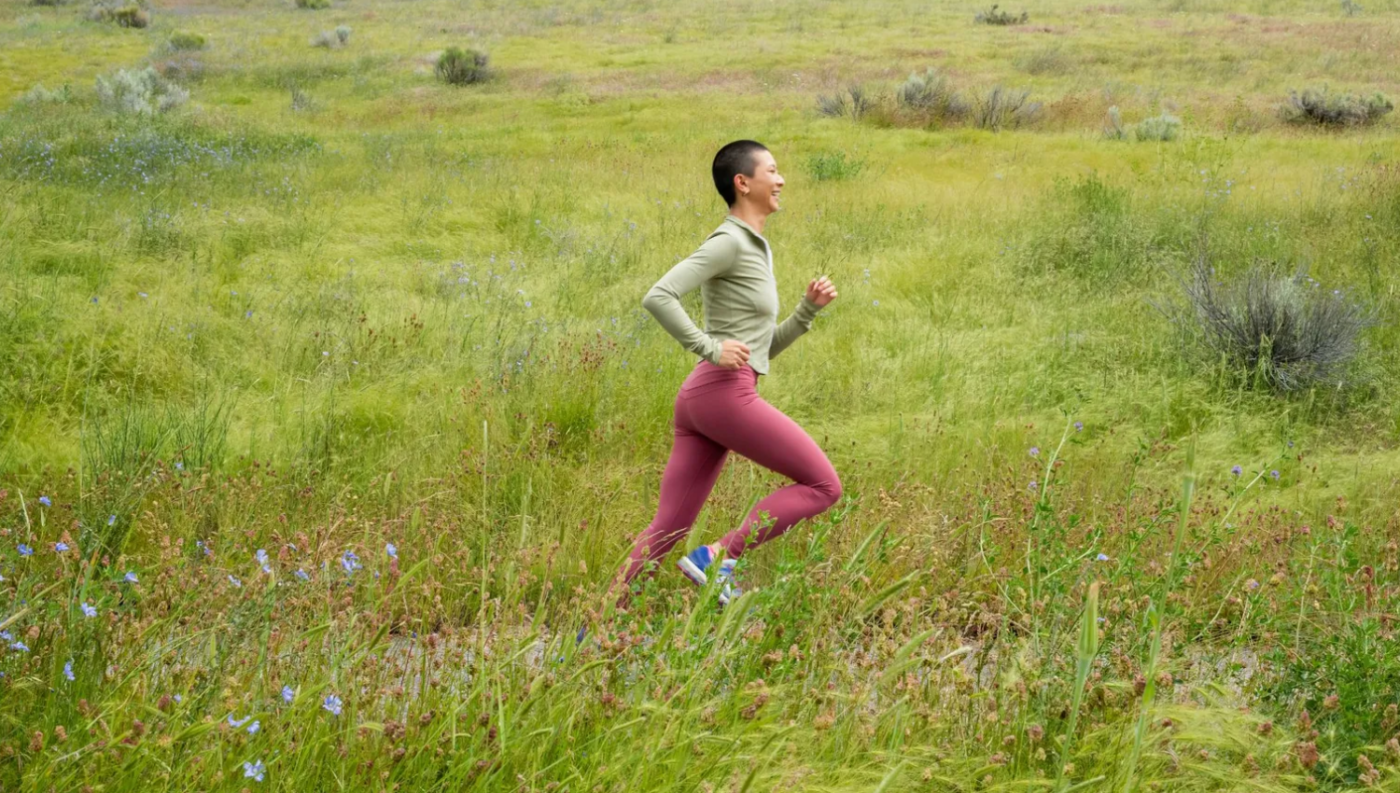
After a marathon left me flat and a heatwave finished the job, I took my runs off-road — and remembered why I used to love this.
Two things I’ve learned this summer. The first is that back-to-back heatwaves mean rethinking your training rather than sitting it out until September. The second is more practical: wherever you’re running, know where the nearest water is.
Both lessons came from failing. I’d been trying to hold onto my usual twice-weekly run through the worst of the early summer heat, and it wasn’t working.
The truth is the problem started well before the weather. I ran a marathon a few years ago and have never quite recovered my appetite for the sport since. Lacing up stopped feeling like a reward and started feeling like admin. My performance said the same thing. I’d come home flat, with none of that post-run high I used to bank on, and dragging myself out in 30-degree heat wasn’t going to fix it.
Apparently plenty of people hit the same wall at the same time of year. Research commissioned by Vital Proteins found that 40% of us feel more pressure to be active in summer than in any other season, while 63% say the heat itself leaves us depleted. Pressure up, energy down. No wonder July feels like a losing battle.
So I stopped chasing performance and went looking for movement I’d actually enjoy. Which is how I ended up agreeing, with roughly equal parts excitement and nerves, to try trail running.
Why running outdoors does more than running indoors
There’s decent evidence behind the switch. Research published in the journal Extreme Physiology & Medicine has looked at so-called green exercise and found benefits to both physical and mental health beyond what the same effort delivers inside.
First, though: what actually counts as a trail run? Less than you might think, according to personal trainer Ben Walker, founder of Anywhere Fitness. He describes it as running across varied terrain rather than a single consistent surface — forest paths, mountain tracks, coastal routes, gravel, grass, mud, rock. A road run is planned on a predictable surface. A trail run isn’t predictable at all, and that’s the point.
It interrupts the loop in your head
Consultant psychologist Dr Elena Touroni, co-founder of The Chelsea Psychology Clinic, says a lot of people spend most of their day inside their own thoughts, circling the same worries without ever getting clear of them. A treadmill won’t help with that. An outdoor environment can, because it keeps changing — sightlines, light, sounds that no screen has curated for you. That volume of sensory information gives the brain something else to work on, and Touroni rates it as one of the more effective natural interruptions to rumination.
It settles the nervous system
The unpredictability does something too, she says. Ground shifting underfoot, light changing, noise that isn’t coming out of a speaker. The body reads environmental cues, and when those cues suggest safety rather than strip lighting and deadlines, the physiological response is measurable. A controlled indoor space can’t reproduce it.
It resets your sense of scale
This was the part I recognised most. Touroni says what surprises people isn’t a lift in mood so much as a return of proportion. Her clients describe putting down something they hadn’t noticed they were carrying, or feeling smaller against the scale of the landscape — and finding their problems shrink along with them.
It works you harder than a flat route
Walker is clear that the physical return is significant. Constant changes in gradient recruit both the aerobic and anaerobic systems: the anaerobic side fires when you push up and down hills, so you’re drawing on fat through one system and carbohydrate through the other. Varied terrain makes demands on more components of your fitness than a steady road run does.
Who should hold off
Almost anyone can get there, but Walker doesn’t recommend diving in. His view is that trail running suits people who’ve already been running consistently on even ground and have done the resistance work to back it up. Balanced strength through the lower body matters most, because uneven ground punishes compensation: lean on one muscle group and the knees, hips or lower back pay for it. Strong hamstrings need strong quads. A strong core needs a strong lower back. If you’re heading uphill, he says glute max and glute medius need regular attention, since they’re what stabilises the pelvis and stops you putting a foot wrong.
Duly noted. Not that it saved me.
Week one: I remembered what this used to feel like
I was worried I wasn’t a serious enough runner for this, which the experts talked me out of. I’ve been running for twenty years, give or take a few months off around each of my three children, though family logistics mean my mileage has stalled lately. Add heat, perimenopausal hormones and a chaotic household and my motivation had more or less flatlined.
It came back on day one. Another cloudless morning, too hot to run in open sun, so I walked up to my local woods and started there. Deep shade, soft ground, and scenery good enough that I stopped to look at it — which on a road run I’d have logged as a failure. That was the shift. I was running for the sake of running instead of monitoring pace and cadence.
One caution: trails are quieter than roads. I ran in daylight, told my family where I was going and carried my phone. Take water too, even on a short loop, because getting mildly lost is easy and stretches a 30-minute run into something longer. On one of the hottest days I found a drinking fountain mid-green on a local golf course and have rarely been so pleased to see plumbing.
Week two: buy the shoes first
By week two I was planning routes in my head before I’d even got dressed, which told me everything about how the experiment was going.
Then my back. I hadn’t bought trail shoes, and I jarred my lower back on uneven ground. Walker had flagged the risk: if a disc in your lower back feels at all vulnerable, trails aren’t the place, because inclines and declines load the core and lower back heavily. Proper trail shoes, he says, change your comfort, stability and confidence on rough terrain, and support the arches and ankles enough to take strain off the knees, hips, glutes and back.
I started shopping the same day. Too late — I tweaked the back again lifting weights the following morning, almost certainly a consequence of that heavy footfall on rutted ground. For the rest of the fortnight I downgraded to brisk walking, which soothed my back and, Touroni assured me, does much the same job for the mind. A walk in nature breaks the rumination cycle as effectively as a run, she says, and the regulatory effect on the nervous system is separate from the mood boost of exercise itself.
Which left no room for self-flagellation about pace, and that was the unexpected gift. Patchy signal on the trails meant I abandoned my wearable within days. Just me and the countryside, no data.
Am I keeping this up? Yes. I won’t be winning anything on speed, but I’ve fallen back in love with running, and I’ll take that over a personal best.
How to start, according to Ben Walker
Buy trail shoes first — responsive cushioning and all-terrain grip.
Spend the first three to four weeks on road and track, building conditioning and adaptability while you work on gait and posture.
Stretch quads, hamstrings, glutes and hip flexors for 15 to 30 minutes after every session, and foam-roll those muscles plus the IT band to keep tightness at bay.
Between runs, strengthen the same muscles in the gym along with your core and lower back. Trails will find every weak link.
In weeks five and six, move onto grass and hilly parks. The surface is safe but the give underfoot will test your form. That’s the last step before your first proper light trail run.