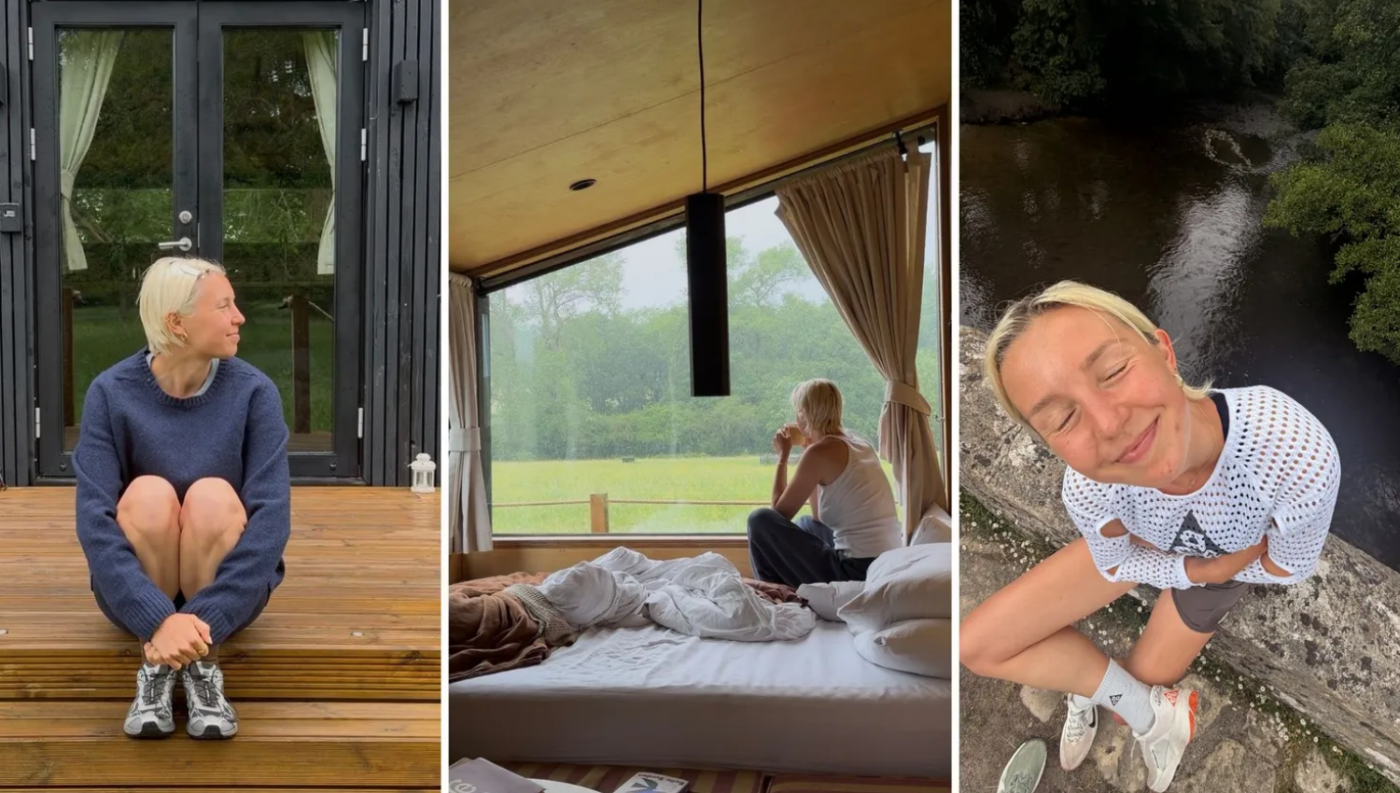
I spent two months building deliberate low-stimulation pauses into my week: reading slots, phone-free walks, washing up by hand. My sleep, mood and focus all shifted within days.
A regulated nervous system has become 2026’s pot of gold. Roughly 1.2 million Instagram posts insist it’s waiting at the end of the rainbow. Very few people I know seem to have actually found it.
I have mixed feelings about the whole conversation. Plenty of us genuinely are overstimulated — permanently connected, pinged all day by notifications engineered to trigger a stress response. That part is real.
What bothers me is the picture we’re sold of the alternative. Regulation gets presented as unbroken serenity: never rushed, never rattled, everything done slowly and mindfully. If you have a full-time job, people who depend on you, rent to cover and a social life to maintain, that image isn’t aspirational so much as insulting. It’s also, as psychotherapist and nervous system specialist David Cornwell explained to me back in April, not the goal. Regulation is not the same thing as permanent calm.
Our nervous systems are built to adapt, moving between high and low stress states throughout the day. Even cortisol, currently blamed for everything from broken sleep to inflammation and heart problems, has research behind it showing it does us good in the right doses.
The thing worth chasing isn’t calm. It’s range: the ability to shift up and down the gears as circumstances demand. That’s what most of us have lost, and it’s why I started scattering deliberate low-stimulation moments through my week. Reading slots. Walks without my phone. Washing up by hand. Small, unglamorous pauses that turned out to be the reset I’d needed for months.
What counts as a low-stimulation moment
Exactly what it sounds like. Nutritionist and hormone specialist Hannah Alderson defines it as a stretch of time where you deliberately cut down how much information your brain has to process. In her new book, Everything I Know About Cortisol, she calls them cortisol calmers.
Her point is that most of us run from email to WhatsApp to a podcast to a meeting to Instagram to Netflix without ever leaving the nervous system a gap to recover in. Cortisol calmers create the small pockets of recovery our biology has always assumed we’d get.
Cornwell frames it the same way: low-stimulation activity is what moves you out of the sympathetic, fight-or-flight state and into rest-and-digest.
The form barely matters. Alderson’s examples include sitting outside with a cup of tea, walking without your phone, reading, dunking your face in ice water, slow breathing, or staring out of a window for five minutes.
Why the small stuff works
Think of these pauses as a buffer against burnout, which is what makes them a long-term health question rather than a self-care flourish.
Cornwell uses a car analogy I keep coming back to. Climbing a hill, a car drops into a lower gear. On the motorway, it moves up. We work the same way, and we need to shift between states depending on what’s in front of us. Stay in top gear permanently and you burn out. That’s the whole mechanism.
Alderson adds the physiological version: chronic stress isn’t the residue of one bad event, it’s what happens when you never switch off from the general overload. Building in recovery supports cortisol’s natural daily rhythm, the diurnal pattern.
Both of them stress that frequency beats scale. A handful of deliberate pauses across a day, Alderson says, will likely do more for you than white-knuckling it until you’re wrecked and then booking a holiday. She points to research showing that ten minutes in nature is enough to support parasympathetic activity. Ten minutes.
How to tell you’re overstimulated
If I’ve learned one thing this year, it’s that the body reports back long before the brain admits anything. Alderson says our bodies are very good at signalling when we’ve spent too long in go mode. The symptoms she sees most often:
Wired and exhausted at the same time. Disrupted menstrual cycles. Being unable to switch your brain off, especially at night. Small tasks feeling insurmountable when they’d normally be nothing. Snapping at people you love, or feeling emotionally raw. Reaching for caffeine, sugar or wine to get through the day. Brain fog and trouble concentrating. Feeling guilty the moment you stop.
I recognised most of that list, which was the point at which I did something about it.
Two months of doing less on purpose
This wasn’t my first round of overstimulation. It creeps up every few months, whenever my workload climbs and my screen-time boundaries quietly dissolve.
The cycle feeds itself. The more overstimulated I get, the less capacity I have for reading or walking, so by the time work ends all I want to do is scroll, which makes tomorrow worse.
So I treated the intervention formally, like an adult star chart. Screens confined to working hours. Waterstones rewards card finally put to use. Here’s what stuck.
Reading, three times a day
I was a bookworm as a kid. Saturday library trips were the highlight of my week, and reading is still the thing that leaves me most creatively charged and emotionally settled.
It’s also the first thing I drop when I’m frazzled, because concentrating on a page feels like too much effort. So I scroll instead, and end up more depleted. I suspect a lot of you know this one.
On day one I gave myself a reading ritual: a £10 weekly allowance for a new book and 20 minutes of reading, three times a day. First thing, in bed with a coffee. After lunch, before the laptop reopens. And last thing at night, with my phone charging in another room.
It became my favourite part of the day within about 72 hours, and it was far easier to maintain than I expected. Keeping a spare book ready meant no dead time waiting to be filled with a scroll, and bookending the day with quiet did something to my sleep almost immediately.
Best thing I’ve read in two months: The Women by Kristin Hannah.
Watering the garden
I am not a plant person. No patience, no instinct, and a documented history of killing a cactus.
But I’ve been living with my dad, who is very proud of his garden, and since he splits his time between our house and his partner’s, the rose bushes, fig trees and wildflowers periodically become my problem.
Turns out it’s regulating. After dinner, when I’d normally collapse in front of the TV with my phone in my other hand, I spend ten minutes with the plants instead. I like the sound of water on leaves and watching the soil darken. It’s absorbing in a way that leaves no room for multitasking, which is the actual mechanism.
Walking without my phone
Movement is good for us. Established. But a hard run or a packed gym can be overstimulating in itself, so I’ve been walking, sometimes as well as a workout and sometimes instead of one.
The phone stays at home. Non-negotiable. If I bring it, one notification turns the whole walk into an inbox with scenery — head down, chin tucked, oblivious to everything around me.
Without it I breathe properly. I notice things, work through whatever’s bothering me, solve the odd problem, daydream. I come back calmer and clearer than I left, and noticeably more productive for the rest of the day.
Washing up by hand
This one started as logistics. There’s no dishwasher at my dad’s. Usually he washes and I dry, but when he’s away both jobs are mine.
It’s become one of my most reliably mindful stretches of the day. I turn off whatever I was watching or listening to, look out of the window and take my time. Revolutionary stuff.
Rather than scrubbing as fast as possible to be done with it, I let myself notice the warm water, the drying, the stacking away. It’s a satisfying sequence, and you’re forced to stay in it because your hands are too wet to reach for your phone between plates.
None of this is novel. There were other additions — yoga, swimming, cooking from scratch — but those four left the deepest mark.
The most surprising part was the speed. Inside a week I was sleeping better, feeling calmer and turning up to work and to friends with actual energy.
It takes boundaries and a bit of discipline, and that’s about all it takes. What it’s convinced me of is that stress isn’t the enemy. It’s protective. You can work with it and still come out of the week intact.